
Nous allons couler!
Franziska Maderthaner

The renowned Austrian artist Franziska Maderthaner interweaves representational and abstract painting. She is a master of her medium. She skillfully incorporates references to art history into her paintings. At the same time, she addresses contemporary themes with Baroque opulence and Rococo-style refinement.
After attending the Akademisches Gymnasium, Franziska Maderthaner studied art education under Herbert Tasquil at the University of Applied Arts Vienna from 1980 to 1985. She met Joseph Beuys and wrote her thesis on his “Free International University: An Attempt to Objectify the Organ for Social Sculpture by Joseph Beuys.”
From 1985 to 1986, she studied graphic arts under Oswald Oberhuber. From June 1984 to March 1985, she served as an assistant to Martin Kippenberger. Franziska Maderthaner has been participating in exhibitions since 1984. After completing her studies, the artist collaborated on various film projects and theater productions. Since 2000, she has been an associate professor of painting and graphic arts at the University of Applied Arts Vienna. From 2004 to 2006, she served as chair of the IG Bildende Kunst (Association of Visual Artists) in Austria. In 2026, she was elected the new vice president of the Künstlerhaus in Vienna.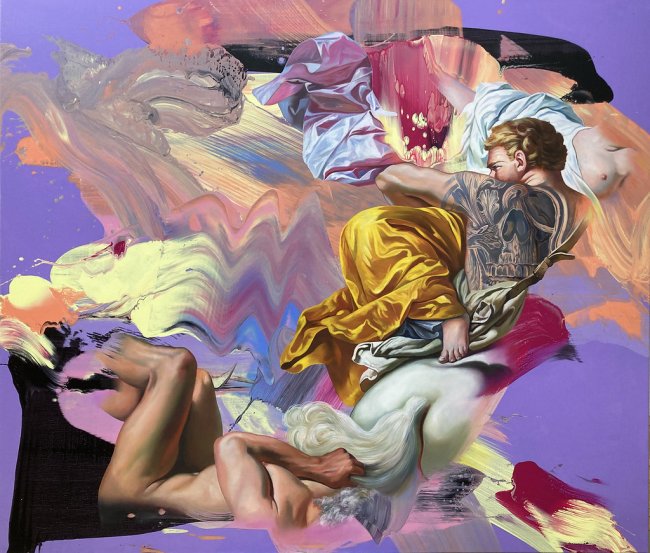
Franziska Maderthaner
Horsepower
2026
oil and acrylic on canvas
170 x 200 cm
Franziska Maderthaner’s works combine gestural, abstract painting with representational, realistic motifs. Both contemporary themes and subjects from art history emerge from the amorphous worlds of color. “Horsepower” unfolds with an almost violent dynamism. Upon closer inspection, we recognize a centaur abducting a woman, while Hercules, in mid-fall, is still trying to stop the hybrid creature. The myth of civilization versus nature is skillfully rendered here.
Franziska Maderthaner
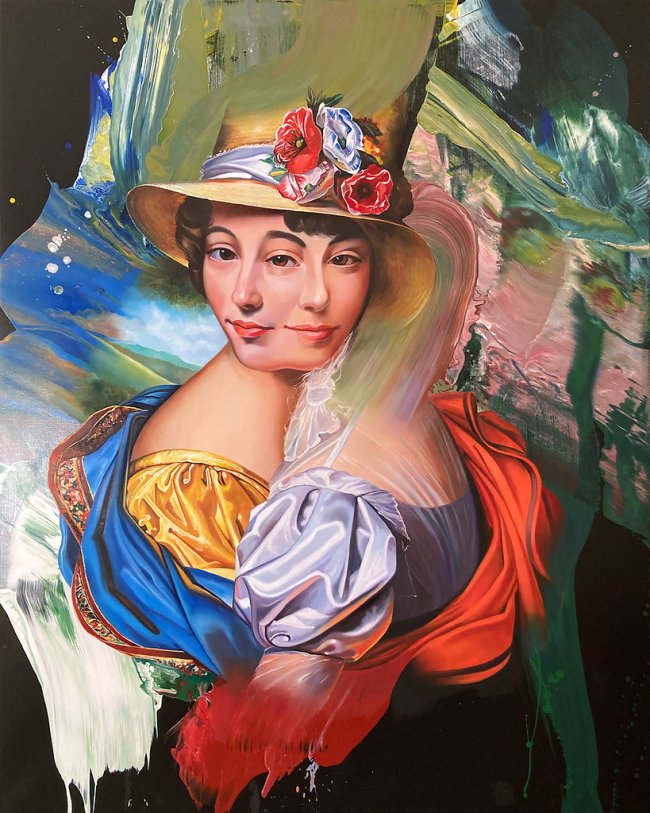
Lady Terflinta
2026
oil and acrylic on canvas
200 x 160 cm
“Lady Terflinta” is a perplexing double portrait of the same woman. The work refers to any woman who embodies the perspectives of both a TERF (Trans-Exclusionary Radical Feminist) and a FLINTA (women, lesbians, intersex, non-binary, trans, and agender people)—just as the artist herself does.
Franziska Maderthaner
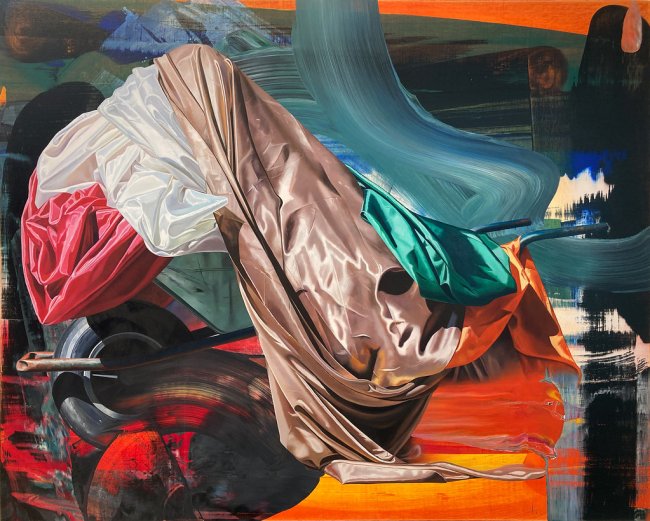
Unterwerfung
2025
oil and acrylic on canvas
160 x 200 cm
“Unterwerfung” refers to Michel Houellebecq’s best-known novel. A human figure, pitifully transported in a wheelbarrow, is draped in shimmering fabrics rendered with masterful brushwork. This serves as a reminder that certain ideologies and religions still view and treat women as slaves and objects today.
Franziska Maderthaner
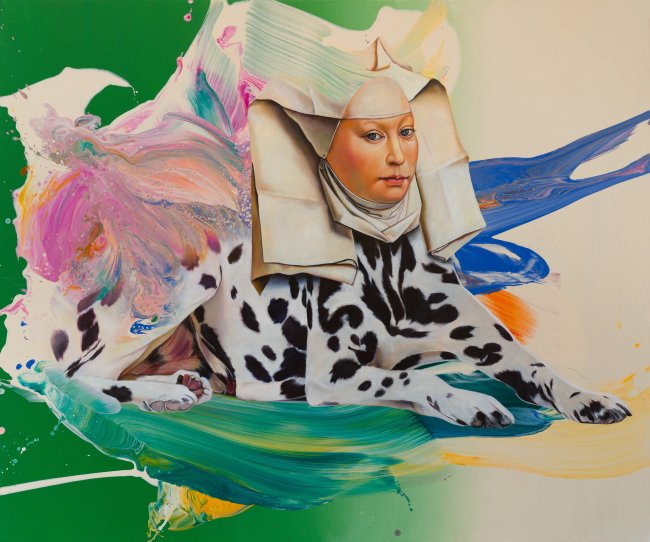
Wart's ab
2024
oil and acrylic on canvas
100 x 120 cm
“Wart's ab” revisits the motif of the sphinx—her patience and her cunning. The artist combines a dog’s body (a Dalmatian) with a female head—the same winged hood we’ve already seen in the work of the Flemish painter Rogier van der Weyden (c. 1440). She uses the composition to stage a masterful display of artistic power—the portrait, animal anatomy, textures, and abstract background are all brilliantly executed.
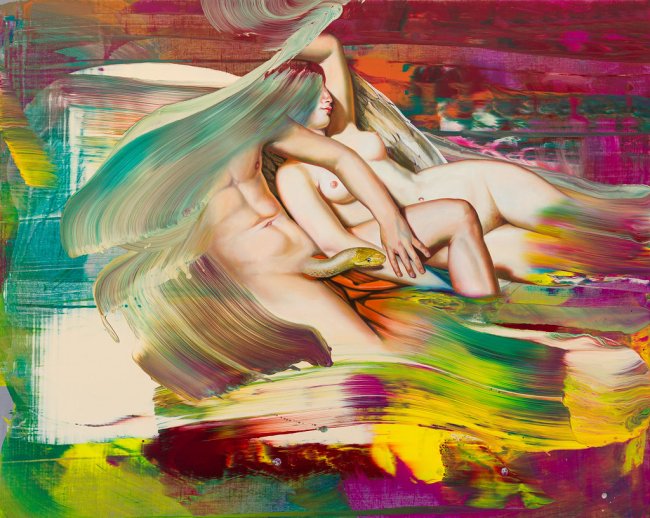
Franziska Maderthaner
Paradise
2026
oil and acrylic on canvas
120 x 150 cm
In Franziska Maderthaner's "Paradise," the Fall of Man has already taken place, and, freely paraphrasing Freud, the serpent has moved from the tree to Adam's front. The transition from the glazed figures to the abstract surroundings is seamless.
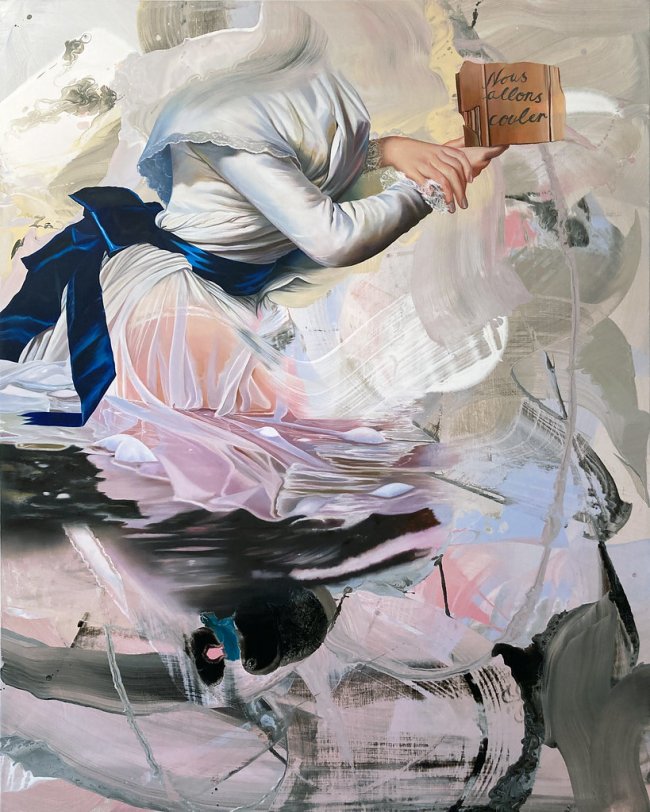
Franziska Maderthaner
Nous allons couler!
2025
oil and acrylic on canvas
200 x 160 cm
The phrase “Nous allons couler” (“We are going to sink”) is attributed to Marie Antoinette, who was executed by guillotine during the French Revolution. The magnificently painted female figure is wearing a dress in the style that was fashionable in the late 18th century. Currently, the phrase is being used in the context of the French immigration debate. It also symbolizes rising sea levels and the climate crisis.